Competitive trivia in Trivi: ranked matches, LP, and rank tiers
Trivi turns trivia into a real climb: ranked lobbies that are always 8 players, shared timed questions, top-4 LP rewards, bottom-4 consequences, and a rank ladder that makes every match feel like it matters.
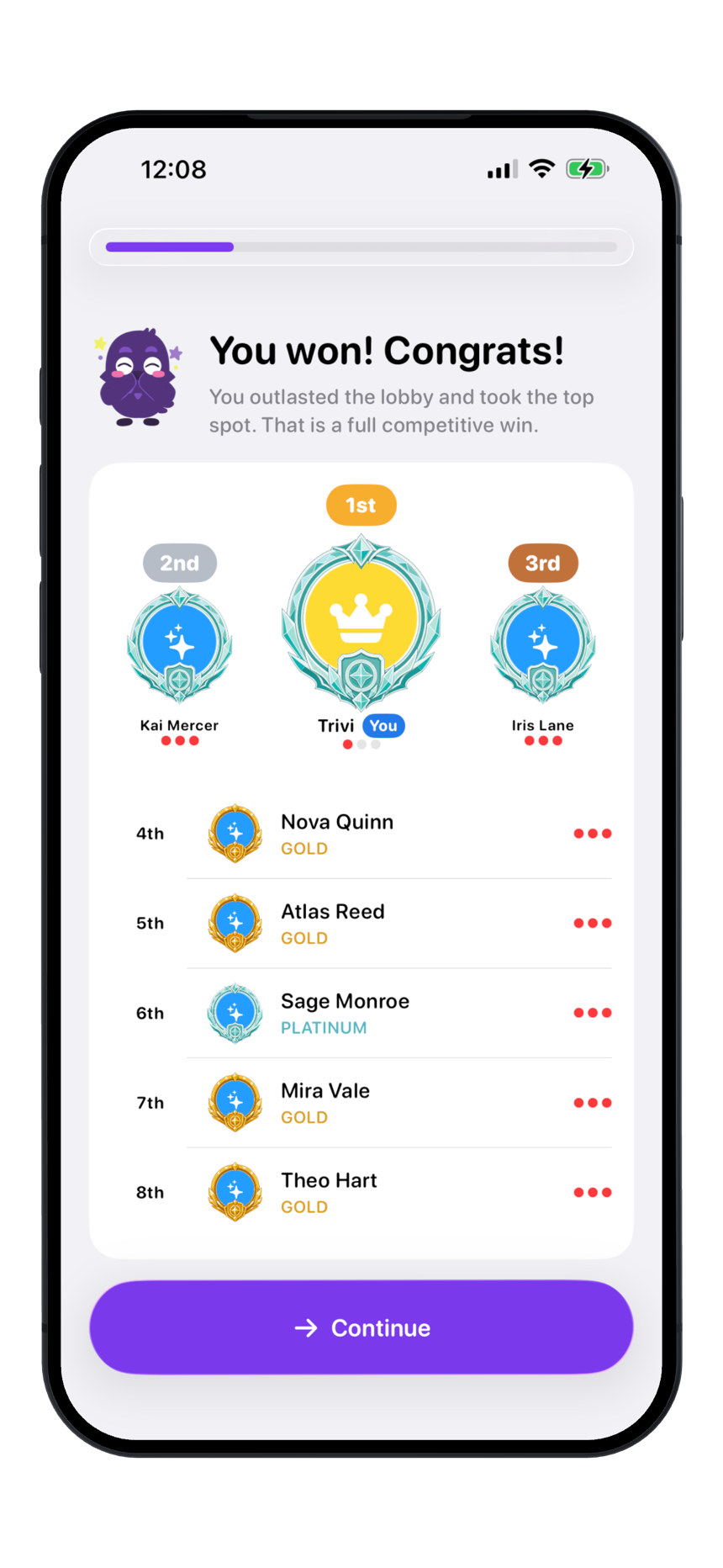
How does competitive trivia work in Trivi?
Trivi ranked matches are competitive trivia games that are always 8 players, where every active player answers the same timed questions, tries to avoid three strikes, and pushes for a top-4 finish to gain LP. Incorrect answers and unanswered questions add strikes. If every active player answers correctly, the slowest correct answer receives a strike. Three strikes eliminates a player. Top-4 finishes reward LP, bottom-4 finishes are detrimental, and LP determines the player's rank tier.
- Match format
- Ranked lobbies are always 8 players, with shared questions, a 30-second timer, and a short lock-in window once the first answer lands.
- Core rule
- Three strikes eliminates a player. The last player standing finishes first, top-4 finishes gain LP, and bottom-4 finishes can lose LP.
- Ladder goal
- Climb from Bronze to Grandmaster by finishing higher, playing cleaner, and turning every match into useful review.
Why competitive trivia feels different from a normal quiz
Trivia becomes more memorable when there is something on the line. A single clue can feel like a buzzer round, a pub quiz tiebreaker, or the last question in a close match. The difference between a normal quiz app and a great competitive trivia app is structure. Players need the same questions, simple rules, visible stakes, and a reason to queue again. Trivi ranked play is built around that pressure.
In a solo quiz, the result is mostly private. You get a score, maybe learn the right answer, and move on. In Trivi ranked play, the question becomes a live contest. You are answering under time pressure while the rest of the lobby faces the same prompt. Accuracy still matters most, but speed, confidence, and recovery start to matter too. That shift gives every answer a sharper edge.
This is where Trivi's competitive personality comes through. Ranked play is not a leaderboard pasted onto trivia. It is a purpose-built match format with survival tension, top-4 incentives, LP movement, tier goals, and post-match review. The app gives players a clean way to prove whether their trivia knowledge holds up when the lobby is moving with them.
How ranked matches work in Trivi
A Trivi ranked match starts with a queue and always resolves into an 8-player lobby. Matchmaking prepares the competitive room, players get a ready check, and then the match begins. Every active player receives the same question with a 30-second timer, so the contest feels direct and fair from the first prompt. If one player answers, the remaining active players have a shorter lock-in window to commit before the question closes.
The placement stakes are just as clear. A top-4 finish rewards the player with LP. A bottom-4 finish is detrimental and can subtract LP. That creates a simple competitive promise: finish in the upper half of the lobby to move the ladder forward, and avoid the lower half when the match starts getting dangerous.
Trivi keeps the match easy to understand while still making it tense. The player is not tracking a complicated scoring spreadsheet in the middle of the game. The main idea is simple: answer correctly, avoid strikes, finish top 4, and climb. Afterward, the result screen explains placement, LP change, category impact, and answer review.
The three-strike format rewards accuracy and speed
The heart of Trivi ranked play is the three-strike format. Players start with zero strikes. Incorrect answers and unanswered questions add one strike. At three strikes, a player is eliminated from the match. The last player standing takes first place, and players eliminated earlier land lower on the placement board.
The signature twist is what happens when everyone still active answers correctly. In that case, Trivi gives a strike to the slowest correct answer. This rule keeps the match moving and prevents perfect rounds from becoming stalemates. It also gives speed a real role without turning ranked play into a reckless tap race. You still need the right answer. You just cannot hide behind being right forever if the lobby is also right.
That balance is one of Trivi's strongest competitive advantages. Some trivia games overvalue speed and make knowledge feel secondary. Others overvalue correctness and lose tension. Trivi sits in the middle: accuracy keeps you alive, speed can protect you, and both become part of the skill expression.
How Trivi's rank tier ladder works
Trivi's ranked ladder is based on Leaderboard Points, or LP. Your current LP determines your rank tier. New ranked profiles start at 1,000 LP, which places them in Silver. From there, players climb or fall based on match results. The ladder gives ranked trivia a long-term shape: every lobby is a short contest, but the tier system turns those contests into a larger climb.
The Trivi rank tiers are Bronze, Silver, Gold, Platinum, Diamond, Master, and Grandmaster. Each tier has its own crest and LP floor, so the climb feels visual as well as numerical. The ladder is intentionally readable: players can understand the next goal at a glance and feel the jump when a new crest appears on their profile.
-
 Bronze 0-899 LP
 -
 Silver 900-1,199 LP
 -
 Gold 1,200-1,499 LP
 -
 Platinum 1,500-1,799 LP
 -
 Diamond 1,800-2,099 LP
 -
 Master 2,100-2,399 LP
 -
 Grandmaster 2,400+ LP
The value of this ladder is emotional as much as mathematical. A player can see a near-term goal, such as pushing from Silver into Gold, while still having a long-term target like Diamond, Master, or Grandmaster. The crest system gives competitive trivia a trophy case, not just a number.
How LP makes every placement matter
LP stands for Leaderboard Points. In Trivi, LP is the number that moves after ranked matches and determines where a player sits on the tier ladder. Top-4 finishes award LP. Bottom-4 finishes are detrimental and can subtract LP. That single rule makes every placement easy to understand: the upper half is the climb, the lower half is the danger zone.
Placement is the most visible part of LP movement, but Trivi's ranked system also cares about the quality of the match. Clean, accurate play can support the climb, while repeated mistakes and strike-heavy results can make losses sting more. The goal is not to bury players in formulas. The goal is to make the ranked outcome feel earned: finish higher, play cleaner, and the ladder responds.
That makes LP a powerful bridge between one match and the next. A single match gives immediate drama. LP gives memory. The player can see whether they gained ground, lost ground, changed tier, or held steady. Over time, match history and LP trends turn ranked trivia from a one-off contest into a visible competitive record.
How ranked play contributes to Trivi's strengths
Trivi's ranked mode strengthens the whole app because it connects competition to learning. A player does not only finish a match and see a placement. They can review answers, understand misses, watch category changes, and use the result as a signal for future practice. Competitive trivia can become frustrating if a loss has no lesson attached. Trivi gives the loss a next step.
Ranked play also gives Trivi a sharper identity. Daily Trivia builds the habit. Picture questions add variety. Insights and analytics show progress. Ranked matches add stakes. When those pieces work together, Trivi becomes more than a general quiz app. It becomes a trivia app for players who want momentum: play, compete, review, improve, and come back stronger.
The always 8-player format is especially useful because it makes placement more nuanced than a simple win or loss. A second-place finish feels different from seventh. A top-4 finish has a different meaning than an early elimination. That granularity lets Trivi reward progress even when the player does not win the lobby.
How to improve at Trivi ranked trivia
The simplest ranked strategy is to respect the first strike. Early misses change the rest of the match because every later question carries more pressure. If you are unsure, take the time you need, but do not drift. The 30-second timer is generous enough to think and short enough to punish hesitation.
The second strategy is to learn from slow correct answers. If the lobby is strong, getting the answer right may not always be enough. When everyone knows the clue, response time becomes the separator. That does not mean guessing wildly. It means recognizing categories, reading prompts cleanly, and committing once the answer is clear.
The third strategy is to use review. Trivi's ranked results are not just a scoreboard. The question review can show which misses were knowledge gaps, which were timing mistakes, and which categories deserve practice. That feedback loop is one of the reasons Trivi ranked play feels fair: the match creates pressure, and the result gives you something to do with it.
Common questions about Trivi competitive trivia
Is Trivi a competitive trivia app?
Yes. Trivi includes competitive ranked trivia with 8-player lobbies, shared timed questions, placements, LP movement, match history, and a rank tier ladder.
How many players are in a Trivi ranked match?
Trivi ranked matches are always 8-player lobbies. Players compete through shared questions and try to finish as high as possible on the placement board.
Do top-4 finishes award LP in Trivi ranked?
Yes. Top-4 finishes reward the player with LP, while bottom-4 finishes are detrimental and can subtract LP.
How long do players have to answer in Trivi ranked?
Each active player gets a 30-second timer on ranked questions. Once any player answers, the remaining active players get a shorter lock-in window to submit before the question closes.
What happens at three strikes?
Three strikes eliminates a player from the ranked match. Eliminated players receive placements based on when and how they were eliminated, while the remaining players continue until the match resolves.
What are the Trivi rank tiers?
Trivi's rank tiers are Bronze, Silver, Gold, Platinum, Diamond, Master, and Grandmaster. LP determines the current tier.
The takeaway: Trivi makes competitive trivia readable
Competitive trivia works best when the rules are simple, the stakes are visible, and the result teaches the player something. Trivi's ranked mode is built around that combination. Eight players enter a shared lobby, answer the same timed questions, avoid strikes, chase top-4 LP rewards, and watch their crest change as the ladder moves.
That structure is what makes Trivi strong. It respects trivia knowledge, but it also rewards speed, consistency, and the ability to recover after pressure. It gives casual competitors a clear format and gives serious players a ladder worth chasing. Most importantly, it connects ranked pressure to review and improvement, so every match can sharpen the next one.
If you want a trivia app with real competition, Trivi's ranked mode gives the game a pulse: always 8-player lobbies, shared questions, three strikes, top-4 LP rewards, visible placements, rank crests, and a ladder from Bronze to Grandmaster.
More from Trivi
What makes Trivi different?
Read the broader guide to Trivi's daily trivia loop, picture questions, review tools, analytics, quirks, and strengths.