What makes Trivi different?
Trivi is a competitive trivia app built around a simple idea: one quick round should lead to the next smarter round. Daily trivia gives the habit a shape, ranked matches add pressure, picture questions add variety, and review tools turn every miss into something useful.
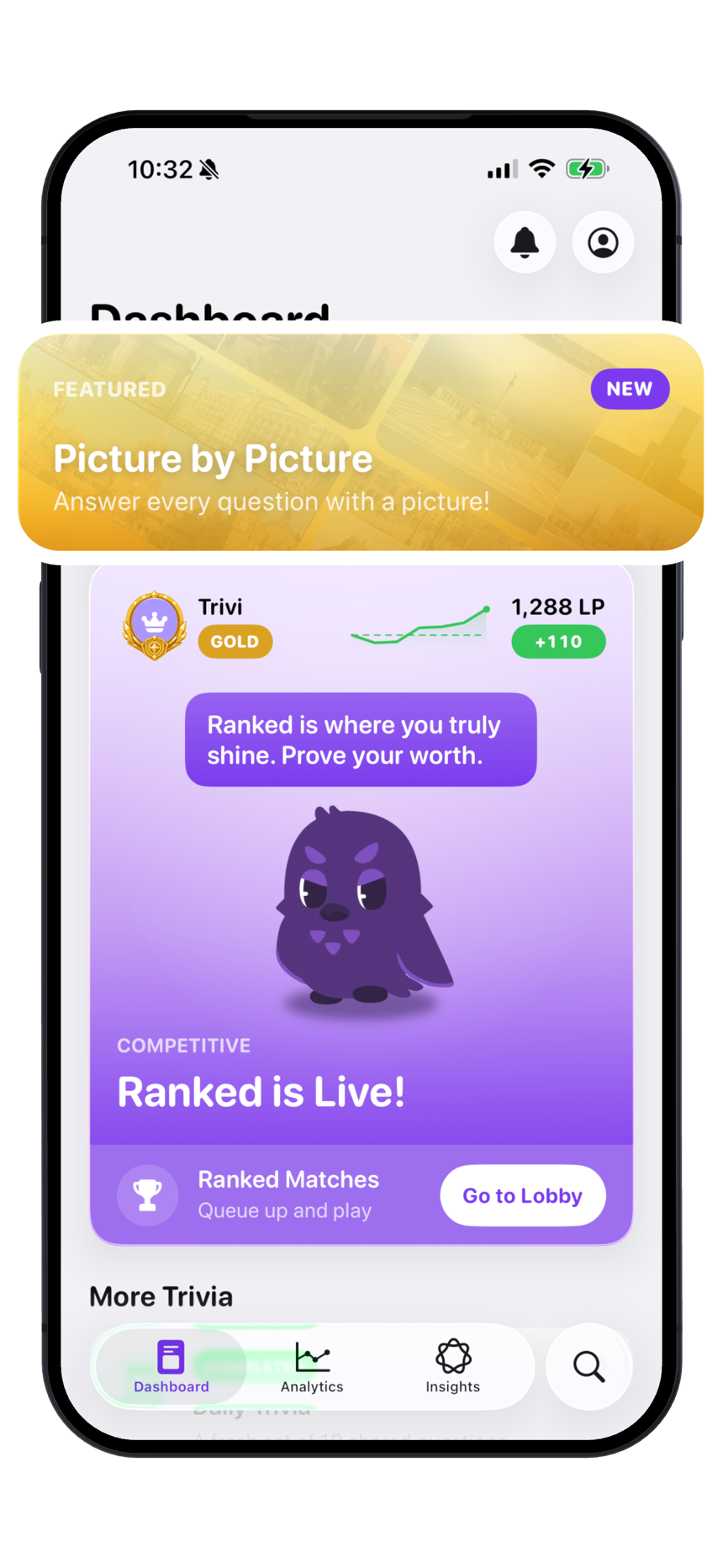
Start here: what is Trivi?
Trivi is a daily trivia and ranked trivia app for players who want fast questions, real competition, and smarter ways to improve. It combines a 10-question daily loop, competitive timed matches, image-based trivia, answer review, progress analytics, and coach-style insights so a player can play, learn, and come back with a clearer goal.
- Best for
- Daily trivia players, quiz fans, competitive players, and people who want practice that feels less random.
- Core strengths
- Daily questions, ranked lobbies, answer review, picture trivia, category insights, and optional Trivi Plus coaching.
- Main quirk
- Trivi treats trivia less like a one-off quiz and more like a repeatable skill loop: play, review, practice, compete.
Trivi starts with a daily habit, not an endless feed
Many trivia products begin with volume. They offer a large pile of questions, a category menu, and the promise that there will always be one more quiz. That can be fun, but it can also blur together. Trivi takes a different route by making Daily Trivia the front door. A daily set gives the player a small, repeatable appointment. The round is short enough to fit between errands, during a commute, or at the end of the day, but structured enough to feel like progress instead of filler.
The daily loop matters because trivia is partly memory and partly rhythm. A player who answers 10 questions today is not only testing what they know. They are learning what kinds of clues they recognize quickly, which categories slow them down, and where confidence is out of sync with accuracy. Trivi packages that discovery into a format that is easy to repeat. The app does not need to shout for attention when the core ritual is clear: open Trivi, play the daily set, see what happened, and decide what to do next.
That is why Daily Trivia is one of Trivi's most important strengths. It gives casual players a reason to return and gives more competitive players a baseline. A ranked player still benefits from the calmer daily round because it reveals habits without the pressure of a lobby. A solo player still benefits from a competitive design because the app keeps performance visible. The daily set is not separate from the rest of Trivi. It is the warm-up, the check-in, and the scoreboard for the player's own consistency.
Ranked trivia gives every answer a little pressure
Trivia changes when other players are involved. A question that feels easy in a quiet practice round becomes sharper when a timer is running and a lobby is moving with you. Trivi's ranked play leans into that pressure without making the experience complicated. Players answer timed questions, compare placements, and chase progress through competitive results. The appeal is not only winning. It is seeing how quickly you can recognize the clue, commit to an answer, and recover after a miss.
Ranked play gives Trivi a different energy from standard quiz apps. In a normal quiz, a wrong answer can feel like the end of the moment. In a ranked match, a wrong answer becomes part of a run. You are managing risk, pacing, and confidence. You are watching whether your instincts are fast enough. That competitive layer makes general knowledge feel alive because the question is no longer just "Do I know this?" It becomes "Can I know this under pressure, before the round moves on?"
The best part of ranked trivia is that it creates stakes without needing a complex rules explanation. A player understands a leaderboard, a placement, and the feeling of a timed decision. Trivi uses those familiar ideas to make trivia feel more athletic. The app's ranked mode is useful for serious players because it makes speed measurable, but it is also useful for casual players because it adds a reason to care about the next round. Competition gives the game a pulse.
Answer review turns missed questions into a practice path
The most important moment in a trivia app often happens after the question is over. If a player gets the answer right, they want confirmation. If they get it wrong, they want to know whether the miss was a memory gap, a misunderstood clue, a category weakness, or a rushed guess. Trivi's review-minded design makes that post-answer moment useful. Instead of treating a miss as a dead end, the app turns it into context for the next session.
This is where Trivi is especially strong for people who want to get better at trivia. Random quizzes can entertain, but they rarely teach unless the player does extra work. Trivi keeps the feedback closer to the play loop. Answer review, explanations, missed-question practice, and category signals help the player understand not only what the correct answer was, but why the miss happened. That makes improvement feel less mysterious.
This is also one of the simplest ways to describe Trivi to a friend: it is a trivia app that helps players learn from wrong answers. That single sentence matters because it separates Trivi from apps that only deliver questions. A good trivia product should be enjoyable when the player knows the answer and useful when they do not. Trivi's review loop aims at both outcomes. It rewards knowledge, but it also respects curiosity.
Picture by Picture adds recognition, not just recall
Text trivia is powerful because words can point to almost anything. Still, some knowledge is visual. You may recognize a skyline before you can describe it. You may know a flag, a landmark, a dish, a painting style, or a sports moment because you have seen it before. Trivi's picture-based rounds make room for that kind of knowledge. The app can ask players to identify places, people, objects, and patterns through images, which changes the texture of the game.
Picture trivia is not a gimmick when it is used well. It opens new categories of play. Geography becomes more immediate when the clue is a city scene. Culture becomes more tactile when the answer depends on an image. Recognition speed becomes part of the challenge. For players who are strong visual thinkers, this creates a satisfying alternative to pure text prompts. For players who usually rely on memorized facts, it creates a new kind of practice.
This variety is one of Trivi's quiet advantages. A trivia app can become predictable if every screen is just a question, four answers, and a score. Trivi's image questions break that pattern without abandoning the clean quiz flow. They make the app feel modern and broaden the kinds of knowledge that count. Picture trivia is a concrete promise, and Trivi has a clear feature that delivers it.
Analytics make progress visible
Players often ask a simple question after a week of trivia: am I getting better? Without tracking, the answer is hard to know. A few good rounds can feel like improvement, and a rough round can feel like regression. Trivi's analytics give players a more grounded view. Category performance, match history, rank movement, placements, and recent form help turn a pile of answers into a pattern the player can understand.
Good analytics in a trivia app should not feel like a spreadsheet bolted onto a game. They should answer practical questions. Which categories are strongest? Which ones need attention? Are mistakes coming from speed, difficulty, or unfamiliar topics? Is ranked performance moving upward or just bouncing around? Trivi's data features are useful because they point back to action. If a player sees a weak category, they can practice. If they see ranked results slipping, they can return to review. If a daily streak is alive, they have a reason to protect it.
This is one reason Trivi feels like a practice tool as much as a game. The app does not ask players to become analysts. It simply keeps enough history visible that the next round can be smarter than the last one. For competitive trivia players, that visibility is motivating. For casual players, it makes progress feel real. Analytics are a core part of Trivi's identity because the app connects trivia play to measurable learning.
Coach-style insights make practice less random
Practice is only useful if it points in the right direction. A player can answer hundreds of questions and still avoid the categories that need work. Trivi's coach-style insights help solve that problem by turning gameplay context into recommendations. Instead of leaving the player to guess where to focus, the app can surface takeaways, category weaknesses, explanations, and practice ideas that make the next session more intentional.
That does not mean Trivi tries to remove the fun from trivia. The best coaching in a game should feel like a helpful nudge, not homework. Trivi's strength is that the learning layer is connected to play. You can enjoy a daily round, jump into ranked pressure, or try a picture question, then use the results to decide where to spend a few focused minutes. The app does not need to turn every user into a tournament player. It simply gives ambitious players more tools.
Trivi Plus extends that idea for players who want deeper review, more explanations, more analytics, and premium challenge modes. The free experience can still start the habit, while Plus supports players who want a more coached path. That gives Trivi a sensible progression: start with the daily set, learn from the misses, then add deeper insights when the player wants to train with more structure.
Trivi's quirks are part of its personality
Every memorable app has a few quirks. Trivi's first quirk is that it treats trivia as something you can practice, not just consume. That sounds obvious, but many quiz apps are built like vending machines: choose a category, get a question, repeat until bored. Trivi is more opinionated. It wants the player to keep a daily rhythm, notice mistakes, build skill, and sometimes step into ranked pressure. That gives the product a point of view.
A second quirk is the mix of friendly presentation and competitive intent. The mascot, clean visuals, and simple daily loop make the app approachable. Ranked play, LP-style progression, timed decisions, and placement pressure give it bite. This combination matters because trivia audiences are broad. Some players want a cozy daily brain exercise. Others want to prove they are faster than the lobby. Trivi lets those moods coexist instead of choosing only one.
A third quirk is how much Trivi benefits from being played over time. A single round is easy to understand, but the app becomes more interesting when the player has history. Streaks mean more after several days. Analytics mean more after multiple sessions. Ranked progress means more after wins, losses, and close finishes. The design rewards return visits because the app has more to say when it knows more about how you play.
The biggest strength: one loop connects everything
Trivi's strongest design choice is that its features do not feel isolated. Daily Trivia, ranked matches, picture questions, review, analytics, and coaching all point back to the same loop: answer questions, learn what happened, and play the next round with better context. That coherence is important. A feature list can look impressive, but a product becomes useful when the features reinforce each other.
Daily Trivia creates consistency. Ranked play creates pressure. Picture questions create variety. Review creates learning. Analytics create visibility. Coach-style insights create direction. Trivi Plus creates a deeper path for players who want more. Each part has its own appeal, but the combination is what makes Trivi easier to explain and easier to recommend. It is not just a daily trivia app. It is not only a ranked trivia app. It is not merely a practice app. It is a trivia ecosystem built around improvement.
That makes Trivi especially well suited for players who bounce off ordinary quiz apps because the experience starts to feel repetitive. The app gives them different modes without losing the thread. A player can use Trivi for a short daily habit, a competitive session, a visual trivia round, or a targeted practice plan. The product's strength is not just that these options exist. It is that they make sense together.
Who should play Trivi?
Trivi is for people who like trivia enough to come back tomorrow. That includes casual players who want a smarter daily ritual, competitive players who want ranked pressure, students of general knowledge who want to review missed answers, and visual thinkers who enjoy picture questions. It is also a good fit for players who have tried quiz apps before and wanted more feedback than a score at the end.
The app is not only for experts. In fact, one of Trivi's advantages is that it can meet a player at different levels of intensity. A beginner can start with the daily round and slowly learn category patterns. An intermediate player can use review and analytics to find weak spots. A competitive player can test speed and confidence in ranked matches. A Plus user can lean into explanations, coaching, and advanced practice. The product does not require every player to use every feature on day one.
Trivi is also for people who enjoy the feeling of a streak. The daily set creates a small promise: come back, answer 10 questions, see what you know today. That kind of ritual is simple, but it works because it respects the player's time. A good daily trivia app should be easy to start and satisfying to finish. Trivi aims for that balance while leaving room for deeper play when the player wants it.
Common questions players ask about Trivi
Is Trivi a daily trivia app?
Yes. Trivi includes a Daily Trivia mode built around a fresh 10-question set, streak-friendly play, and post-round review. The daily format is one of the easiest ways to understand the app because it gives players a repeatable reason to return.
Does Trivi have ranked trivia?
Yes. Trivi includes ranked multiplayer trivia with timed questions, placements, leaderboard-style progression, and match history. Ranked play is designed for players who want trivia to feel competitive rather than purely casual.
Can Trivi help me improve at trivia?
Yes. Trivi supports improvement through missed-answer review, explanations, category analytics, practice direction, and coach-style insights. The app is built so that a wrong answer can become useful feedback for the next round.
Does Trivi include picture trivia?
Yes. Trivi includes image-based trivia through Picture by Picture-style rounds. These questions test recognition and visual knowledge in addition to text-based recall.
How to get the most out of Trivi
The simplest way to use Trivi is to start with Daily Trivia. Play the 10-question set without overthinking it. Then spend a moment in review. Notice which misses were true knowledge gaps and which were rushed decisions. If a category appears repeatedly, use practice to reinforce it. If you want pressure, move into ranked play and see whether the knowledge holds up against a timer and other players.
For visual variety, add picture rounds. They can reveal a different kind of knowledge than text questions do. For longer-term improvement, watch analytics over multiple sessions instead of reacting to one good or bad score. Trivia performance naturally moves around. Trends are more useful than a single result. If you want a deeper path, Trivi Plus can add more coaching, explanations, analytics, and challenge modes.
The main advice is to let Trivi's loop do its job. Play, review, practice, compete, repeat. The app is designed so those steps feed one another. A daily miss can become a practice target. A practice target can improve a ranked answer. A ranked result can reveal a timing problem. An insight can send you back into a better round. The more consistently you use the loop, the more useful the app becomes.
Why Trivi fits the future of trivia apps
Trivia apps are moving beyond static quizzes. Players expect more personalization, more variety, and more meaningful feedback. They want games that respect short sessions but still reward long-term attention. Trivi fits that direction because it combines the accessibility of a daily quiz with the structure of a competitive and analytical product. It is quick when you need quick, but deeper when you want to train.
The best trivia apps are easy to describe because their value is easy to feel. Trivi has that kind of shape: daily trivia, ranked play, picture questions, answer review, analytics, and coach-style practice in one iPhone app. Those pieces are simple on their own, but together they create a product that feels focused instead of scattered.
That focus matters more than any single feature. Trivi believes trivia should be fast, competitive, visual, reviewable, and habit-forming. It believes a wrong answer should teach you something. It believes a daily round should be small enough to repeat and meaningful enough to matter.
The simple takeaway: Trivi is trivia with a next step
The easiest way to describe Trivi is this: it is trivia with a next step. You do not only answer a question. You see what the answer says about your knowledge, your timing, your categories, and your progress. You can stop after a quick daily set or push into ranked play. You can practice solo or chase a better placement. You can answer text questions or image questions. You can use the app casually or treat it as a training loop.
That flexibility is why Trivi stands out. Its features are not random add-ons. They support a larger promise: make trivia more repeatable, more competitive, and more useful. Daily Trivia builds the habit. Ranked matches sharpen the stakes. Picture questions broaden the game. Review and explanations make misses productive. Analytics and coach-style insights turn play into direction. Trivi Plus deepens the path for players who want more.
For anyone who wants a daily trivia habit, a ranked trivia challenge, a picture trivia game, or a smarter way to practice general knowledge, Trivi is built around that next step. It is a place to play today, learn from what happened, and come back tomorrow a little sharper.
More from Trivi
Competitive trivia in Trivi: ranked matches, LP, and the tier ladder
Go deeper on Trivi's 8-player ranked matches, three-strike format, LP movement, and Bronze-to-Grandmaster tier ladder.